· 3 min read
The First Answer That Made Me Think: Okay, This Could Actually Work
The first time the website agent answered a real question from the content I'd collected, it wasn't the AI that excited me. It was seeing my own work come back as an answer.
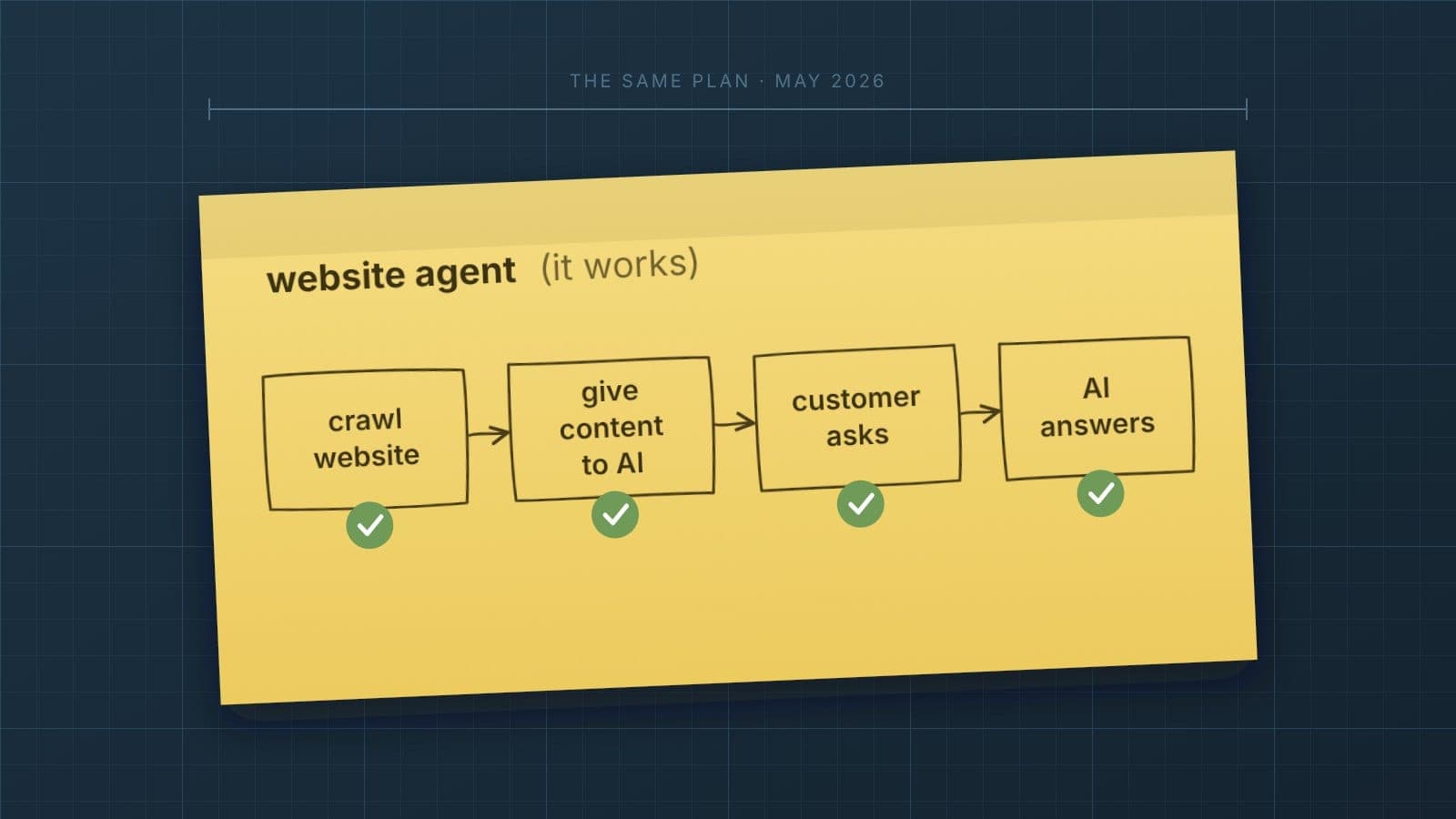
I'd been building toward this moment for two months, and I almost didn't believe it when it happened.
By the end of April, I had all the pieces. The website had been crawled. The manuals had been pulled apart, messily. Everything had been chunked, turned into embeddings, and stored in PostgreSQL. I could ask a question in plain language and get back the right pieces of content.
What I hadn't done yet was the part everyone pictures when they hear "AI." I hadn't handed any of it to a model and asked it to answer.
Wiring the last box
Going back to the sticky note, three of the four boxes had something real behind them. The last one, "AI answers," was still just a box.
The idea was simple enough to say out loud:
- A question comes in.
- Search finds the pieces of content that best match it.
- Those pieces, along with the question, go to the model.
- The model writes an answer using what it was given.
That's the "generation" half of RAG. Retrieval finds the material. Generation turns it into an answer a person can read. I'd read about it plenty of times.
After two months of crawling, cleaning, chunking and storing, this was the step that would finally show whether any of it worked.
The first real answer
The first real question I asked was a simple one. Could I get a product manual?
It gave me the manual. It also gave me a lot of text. Not wrong, exactly, just a lot more than anyone asking that question would want to read. A link and a sentence would have done it.
But it worked. It understood what I was asking, found the right manual, and answered from content I had collected.
I read it twice. Then I went and looked at the pages it had come from, half expecting to find it had made something up.
It hadn't. The answer was built from the content I'd collected. I could see where each part of it came from.
Why it felt different
I'd used ChatGPT plenty before this. I'd seen AI write good answers. That wasn't new.
What was new was that this answer came from our information. Not from whatever the model had picked up on the internet, but from pages I had crawled, text I had cleaned up, chunks I had stored and search I had built. Every step of the pipeline I'd spent the last two months on was sitting underneath that answer.
That's what made it exciting. Not that an AI could answer a question, but that it answered from the data I had built the whole pipeline to provide.
The exciting part wasn't the AI. It was seeing my own work come back as an answer.
For the first time, the idea from the very first post felt real. A website that actually knew its products. Not perfectly, and not for every question, but I could see it.
Okay, this could actually work
I'll admit I spent a while after that just asking it things.
Questions about products. Questions about policies. Questions about shipping and returns. Some answers were great. Some were fine. Every so often one was a little awkward or missed a detail. But overall, it worked far better than I expected.
There was a small doubt sitting in the back of my head, though. I was the one asking the questions. I knew the website. I knew what was in the data. Without really meaning to, I was asking the kinds of questions I already knew it could answer.
Real people wouldn't do that.
The next question
So I kept going. More questions, different phrasing, things I wasn't sure the website even covered.
Most of the answers were still good.
Then one wasn't. And the problem wasn't that it sounded wrong. It sounded completely right.